

Pubblicato il 8 Febbraio 2026
Have you ever found gold? A Ugandan story told as a cartoon, to read here
di Lorenzo D'Angelo e Eleanor Fisher
Across the world, an estimated sixteen million people depend on artisanal and small-scale gold mining. These are miners who work with their hands, with simple tools, in landscapes shaped by hope as well as hardship. Most miners live in low-income countries, where gold is not only a mineral but a livelihood. Artisanal mining is often linked to environmental damage, inequality, and difficult working conditions. Yet it also sustains communities, supports families, and holds the potential to contribute to equitable futures.
GOLD MATTERS was born on these premises and these tensions. It was a transdisciplinary and transcontinental project that, between 2018 and 2022, brought together academics, artists, and mining communities to ask a simple but far-reaching question: “How can small-scale mining become part of a sustainable future?”. The project drew on the strengths of partners across Europe, Africa, and South America, including the University of Reading, the University of Amsterdam, Leiden University, Hamburg University, Campinas State University, Mbarara University, and the Nordic Africa Institute.
Together, we explored four interconnected aims. We examined how sustainable futures might grow out of miners’ lived realities – their “gold lifeways.” We listened to how people inside mining communities define what is sustainable or unsustainable in their environment, their livelihoods, and their relationships. We reflected on how understanding these perspectives can improve governance and wellbeing, especially in relation to gender and local community priorities. And we experimented with new forms of communication, creative forms that brought different visions of the future into dialogue and helped to imagine possibilities beyond the present.
The East Africa Team focused on the shifting landscapes of artisanal gold mining in Uganda. We studied how people make sense of their surroundings, their work, and their futures: how knowledge is shared, how technologies travel from one site to another, and how miners describe what sustainability means to them. Our approach combined remote sensing, ethnography, participatory methods, archival research, and visual art, weaving together different ways of understanding a complex world.
The Ugandan research team included Eleanor Fisher, Lorenzo D’Angelo, Ronald Twongyirwe, Esther van de Camp, and Margaret Tuhumwire. In southwestern Uganda, Lorenzo and Eleanor explored how households combine farming (e.g., plantain bananas, coffee, and other crops) with the search for alluvial gold. They showed how mining and farming support each other in Buhweju, a district where land is fragmented, soil fertility is declining, and young people face limited opportunities. Gold, in this context, becomes not only a source of income but a way of sustaining rural life.
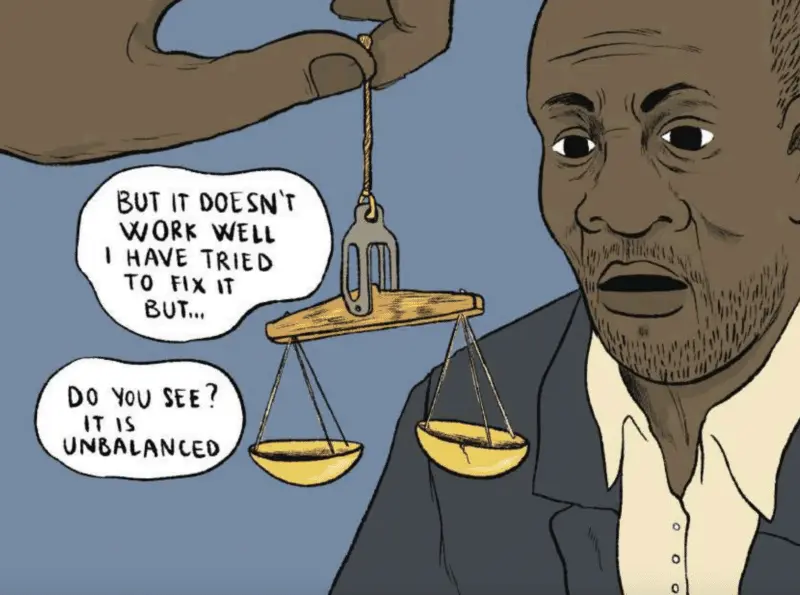
This short graphic novel is one of the visual works created to share these insights with the people of Buhweju and to keep alive a reflection that, we think, it is still timely. It is also a way of returning stories to the communities who inspired them honouring their knowledge, their struggles, and their visions for the future. We hope you will enjoy it.
Lorenzo D’Angelo and Eleanor Fisher
CLIC ON THE IMAGE BELOW THEN CLIC ON THE ARROWS TO READ THE CARTOON HERE
D’Angelo L. - Fisher E. - Mistrello E. _2025_Have you ever found gold (3)
Licence CC BY-NC-ND – Source : D’Angelo, L., Fisher, E., Mistrello, E. 2025. Have you ever found gold? Uppsala, Nordic Africa Institute.
Credit roles
Lorenzo D’Angelo: field research; storyline and text
Eleanor Fisher: editing
Elena Mistrello: drawings
First edition: december 2025
Acknowledgements
We would like to acknowledge the gold miners, members of mining communities, government officials, and representatives of non governmental organisations with whom transdisciplinary research was made possible. They include individuals who have been willing to share their working lives, workplaces, ideas and knowledge, especially Innocent Babweteera, Venansio Nuwamanya, Spiriano Katashaisha, and Fulgyensio Katungye. We also extend thanks to our co-investigator Dr Ronald Twongyirwe, Associate Professor at Mbarara University of Science and Technology
Ethics and consent
Ethical clearance was granted for the project by (i) The School of Agriculture, Policy and Development, University of Reading: 1353D 2020; and, (ii) Mbarara University of Science and Technology, Uganda: MUREC 117, 27/02/2020
Funding sources
The Nordic Africa Institute provided financial support to produce this graphic novel. The research was financed by the Belmont Forum and NORFACE Joint Research Programme on Transformations to Sustainability, co-funded by DLR/BMBF, ESRC, FAPESP, ISC, NWO, VR, and the EC through Horizon 2020 (grant number: 462.17.201) under the project ‘Sustainability Transformations in Artisanal and Small-scale Gold Mining: Trans- regional and Multi-Actor Perspectives’ (‘Gold Matters’) (2018 – 2022)
Post correlati





LaRivistaCulturale.com è Media Partner di AnthroDay 2026. Cliccare per maggiori informazioni sugli eventi in programma a Febbraio e Marzo 2026 a Milano, Torino e Roma

Ultimi articoli

“Naufraghi metropolitani”, nel viavai dei pendolari romani per l’Anthroday
Invito ad una “Passeggiata in Eurasia” per il World Anthropology Day di Roma
Invito al viaggio in Messico. Traiettorie di oggetti e persone tra Europa e Americhe
Immobili per muoversi. I momenti dell’attesa alle fermate degli autobus a Roma
Giuseppe Tucci, esploratore del Tibet, “il paese delle donne dai molti mariti” per l’Anthroday di Roma





Rivista di Antropologia Culturale, Etnografia e Sociologia dal 2011 – Appunti critici & costruttivi